
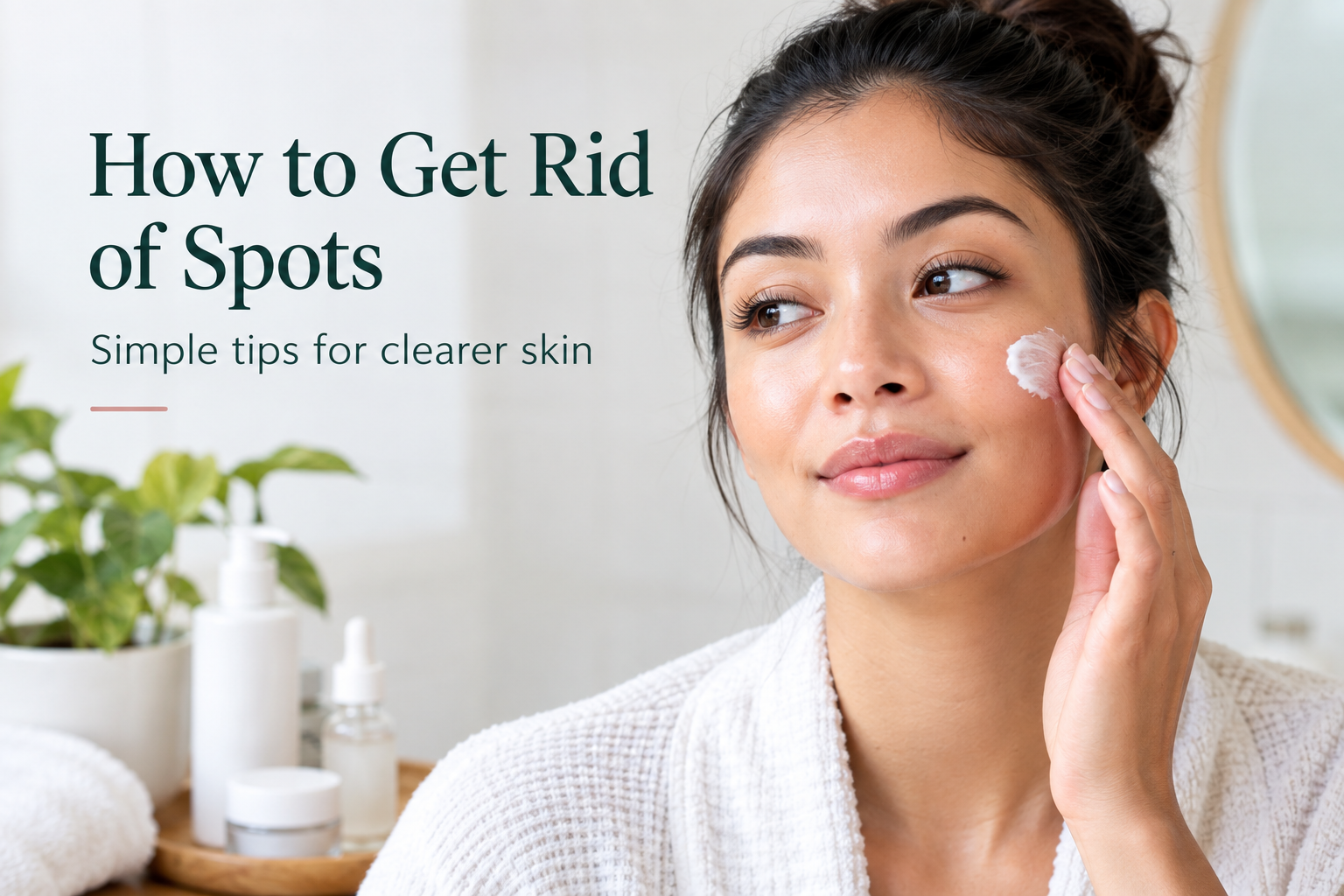
Spots have a habit of appearing at exactly the wrong time. One seems to show up before an important meeting, a night out or a special occasion, and suddenly it is all you can see when you look in the mirror.
If you are wondering how to get rid of spots, the good news is that you do not necessarily need a complicated skincare routine. Understanding what is causing your breakouts and choosing the right products can make a real difference.
There is no guaranteed overnight cure, but there are simple things you can do to calm existing spots, reduce breakouts and look after your skin in the long term.
What causes spots?
Spots usually develop when hair follicles become blocked with oil (sebum), dead skin cells and other material. Hormonal changes can increase oil production, which is one reason spots are particularly common during puberty and other hormonal changes.
Other factors can also contribute to breakouts, including:
- Skincare or makeup that blocks pores
- Picking or squeezing spots
- Hormonal changes
- Certain medicines
- Stress
- Sweat and friction
- Excessive washing or scrubbing
Having spots does not mean that your skin is dirty. In fact, washing your face too aggressively can irritate your skin and make breakouts more uncomfortable.
If you are unsure whether your skin is oily, dry or combination, it is worth understanding your skin type before building a routine. Our guide to creating an effective skincare routine explains how different skin types can have different skincare needs.
How to get rid of spots
1. Cleanse your skin gently
A simple cleanser is a good place to start.
Wash your face gently once or twice a day and after heavy sweating. There is no need to scrub your skin aggressively or use very hot water.
If your skin feels tight, sore or unusually dry after cleansing, your cleanser may be too harsh.
A consistent routine is generally more useful than repeatedly changing products. The Relax in Beauty skincare routine guide also looks at cleansing, toning and moisturising as part of a regular skincare routine.
2. Try salicylic acid
Salicylic acid is a popular ingredient in products designed for acne-prone skin.
It can help unclog pores and remove dead skin cells, making it particularly useful for blackheads and whiteheads. The American Academy of Dermatology lists salicylic acid among established acne treatments.
If you have never used salicylic acid before, start slowly. Using too much too soon can leave your skin dry or irritated.
3. Consider benzoyl peroxide
For red and inflamed spots, benzoyl peroxide is another commonly used acne treatment.
It works differently from salicylic acid and can help reduce acne-causing bacteria. NHS guidance notes that benzoyl peroxide is available from pharmacies and can help treat spots and blocked pores.
Benzoyl peroxide can cause dryness or irritation when you first use it, so introducing it gradually can help your skin adjust. It can also bleach fabrics, so take care with towels, bedding and clothing.
4. Stop squeezing your spots
This is easier said than done, but squeezing spots can make things worse.
Picking can increase inflammation and damage the surrounding skin. It may also increase the risk of scarring or dark marks after the spot has healed.
If you find yourself touching a particular spot repeatedly, a hydrocolloid patch can be useful because it creates a physical barrier between your fingers and your skin.
The NHS also advises against squeezing spots because doing so can make acne worse and contribute to permanent scarring.
5. Keep your skincare routine simple
When spots appear, it is tempting to throw everything at them.
You might buy an exfoliating acid, scrub, serum, mask and several spot treatments and start using them all at once.
Unfortunately, more skincare is not necessarily better.
A simple routine can be much easier to maintain.
In the morning:
- Gentle cleanser
- Treatment product, if needed
- Moisturiser
- Sunscreen
In the evening:
- Gentle cleanser
- Acne treatment
- Moisturiser
Introduce new products one at a time. This makes it easier to see what works for your skin and what causes irritation.
For more ideas on putting together a consistent routine, see our guide to organic skincare routines and choosing products for different skin types.
6. Do not skip moisturiser
If you have oily or acne-prone skin, you might think that moisturiser will make your spots worse.
That is not necessarily the case.
Some acne treatments can leave the skin dry and irritated. A lightweight, non-comedogenic moisturiser can help keep the skin comfortable without unnecessarily clogging pores.
The American Academy of Dermatology notes that moisturiser can be particularly useful when using acne treatments such as benzoyl peroxide or salicylic acid because these treatments can dry and irritate the skin.
7. Use sunscreen every day
Sun protection is an important part of caring for acne-prone skin.
Sun exposure can make pigmentation left behind after spots more noticeable. Some acne treatments can also make your skin more sensitive to sunlight.
A broad-spectrum sunscreen can therefore be useful as part of your daily routine.
Our guide to organic skincare routines also discusses the importance of including sunscreen in a daytime skincare routine.
How to get rid of spots fast
If you have an important event coming up, you may be looking for a way to get rid of a spot quickly.
Unfortunately, there is no guaranteed method that will make acne disappear overnight.
What you can do is avoid making the situation worse. Do not squeeze the spot, avoid repeatedly touching it and consider using an appropriate spot treatment or hydrocolloid patch.
For regular breakouts, treating the underlying acne is more useful than trying to eliminate individual spots as soon as they appear.
How long do spots take to go away?
An individual spot may settle within several days, but treating recurring acne usually takes longer.
Give a new skincare routine time to work rather than changing products every few days. NHS guidance notes that acne treatments can take several weeks or even months to produce noticeable improvement, depending on the treatment.
At the same time, persistent burning, swelling or significant irritation is not something you need to simply tolerate. If a product is causing a strong reaction, stop using it and seek professional advice if needed.
Can toothpaste get rid of spots?
You may have heard that putting toothpaste on a spot can dry it out.
It is best to avoid this.
Toothpaste is formulated for your teeth, not your facial skin, and some of its ingredients can irritate the skin.
If you want to treat a spot, use a product specifically formulated for acne instead. Dermatologists recommend established acne-fighting ingredients rather than toothpaste or other DIY treatments.
Does diet cause spots?
There is no simple answer to whether particular foods cause spots.
Research has investigated possible links between acne and diet, including high-glycaemic foods and dairy products. However, diet is only one potential factor and changing your diet is not a guaranteed cure for acne.
Rather than cutting out large groups of foods unnecessarily, focus on eating a balanced diet and notice whether you consistently see a relationship between particular foods and your breakouts.
When should you see a doctor?
Occasional spots are common, but you should consider speaking to a GP or dermatologist if:
- Your acne is painful or deep
- You develop nodules or cysts
- Your spots are leaving scars
- Your acne is becoming widespread
- Over-the-counter treatments have not helped
- Your skin is having a significant effect on your confidence or wellbeing
The NHS recommends speaking to a GP when acne is moderate or severe, when pharmacy treatments have not controlled it, or when nodules or cysts develop because of the risk of scarring.
You can read the NHS guidance on acne treatment for more information about available treatments and when to seek medical advice.
The bottom line
If you are wondering how to get rid of spots, start with the basics.
Cleanse your skin gently, avoid squeezing spots, moisturise regularly and consider proven acne ingredients such as salicylic acid or benzoyl peroxide.
Most importantly, give your routine time. Clearer skin rarely happens overnight, and constantly changing products can make it harder to work out what your skin actually responds to.
And if your spots are persistent, painful or leaving scars, speak to a healthcare professional. You do not have to simply put up with acne.
Frequently Asked Questions
How can I get rid of a spot overnight?
There is no guaranteed way to make a spot disappear overnight. Avoid squeezing it and consider an appropriate spot treatment or hydrocolloid patch while allowing the skin to heal.
What is the best ingredient for spots?
The most appropriate ingredient depends on the type of acne you have. Salicylic acid can help with blocked pores, while benzoyl peroxide is commonly used for inflammatory acne.
Does toothpaste get rid of spots?
No. Toothpaste is not designed to treat facial acne and can irritate the skin. Use a product formulated specifically for acne instead.
Should I squeeze a spot?
It is generally better not to. Squeezing can increase inflammation and may increase the risk of scarring or dark marks.
How long does it take for spots to clear?
Individual spots may settle within several days, while recurring acne can take several weeks or longer to improve with treatment. Consistency is important.
When should I see a doctor about spots?
Consider seeing a GP or dermatologist if your acne is painful, deep, widespread, causing scarring or has not improved with appropriate over-the-counter treatments.